Water pools at the bottom of a slope after a heavy rain and just sits there for days.
Or a downspout dumps water in the same spot every storm until the soil underneath washes away and leaves a small trench. Maybe it’s simpler than that: a patch of yard stays muddy long after everything else has dried out.
These are common problems for homeowners across Buffalo and Western New York, especially with the mix of heavy rain events, spring thaw, and clay-heavy soil that doesn’t drain quickly on its own. The right stone for drainage can help manage where that water goes and how fast it gets there. But not every stone does the same job.
Decorative stone, drainage aggregate, and structural drainage materials look similar in a photo, and they are not interchangeable once water is actually moving through them.
Why Stone Works for Yard Drainage
Stone helps manage water in a few practical ways. Larger aggregate creates open spaces between each piece, and those gaps give water somewhere to move instead of pooling on the surface or soaking straight into compacted soil.
That same open structure reduces how much soil gets displaced when water moves across it quickly, which is part of why stone shows up so often in channels, swales, and areas below downspouts.
Stone also protects the soil surface underneath it. Bare dirt erodes fast under concentrated flow. A layer of stone breaks up that force and spreads it out, so the ground underneath holds together better over time. In areas that see repeated flow, after every storm, every spring thaw, that durability matters, because bare soil or mulch in the same spot would need to be replaced constantly.
None of this means stone makes water disappear. It doesn’t create infiltration where the soil is too compacted to absorb it, and it can’t fix a poor slope or a missing outlet on its own.
The grading, the slope, the soil conditions, the pipe placement if there is one, and where the water ultimately exits the property all still matter. Stone for drainage works best as part of a design, not as a standalone fix.
Choosing the Best Stone Size for Drainage
Stone size has a direct effect on how water moves through it, and picking the wrong size is one of the more common mistakes homeowners run into.
Small gravel and fine aggregate
Small gravel and material with a lot of fines- the fine particles and dust mixed in with the stone- can work for light surface applications like pathways or decorative beds. For drainage, though, fines tend to compact over time and fill in the gaps that water needs to move through. In a French drain trench or any application where water needs to pass freely, too many fines can defeat the purpose of using stone in the first place.
Medium drainage gravel
Medium gravel is a common choice for general drainage layers, French drain trenches, and areas that see moderate water flow without a lot of force behind it. It strikes a balance, with enough open space for water to move, but still manageable to install and shape by hand.
Larger drainage rock
Larger drainage rock is better suited to areas with visible, moving water, swales, drainage channels, and spots doing active erosion control work. The added weight and size help the stone stay in place under stronger flow, which smaller gravel often can’t do on its own.
River rock and decorative stone
River rock and other decorative stone are rounded rather than angular, and that shape changes how they behave. Rounded stone tends to shift more easily under flowing water because the pieces don’t lock together the way angular crushed stone does.
That doesn’t make river rock a bad choice; it’s often exactly what a homeowner wants for the look of a dry creek bed, but it’s worth being clear that decorative stone and functional drainage aggregate aren’t always doing the same job, even when they’re sitting in the same channel.
There isn’t one size that’s universally correct. It depends on how much water is moving, how fast, and what the stone needs to accomplish in that specific spot.
Using Stone for a French Drain
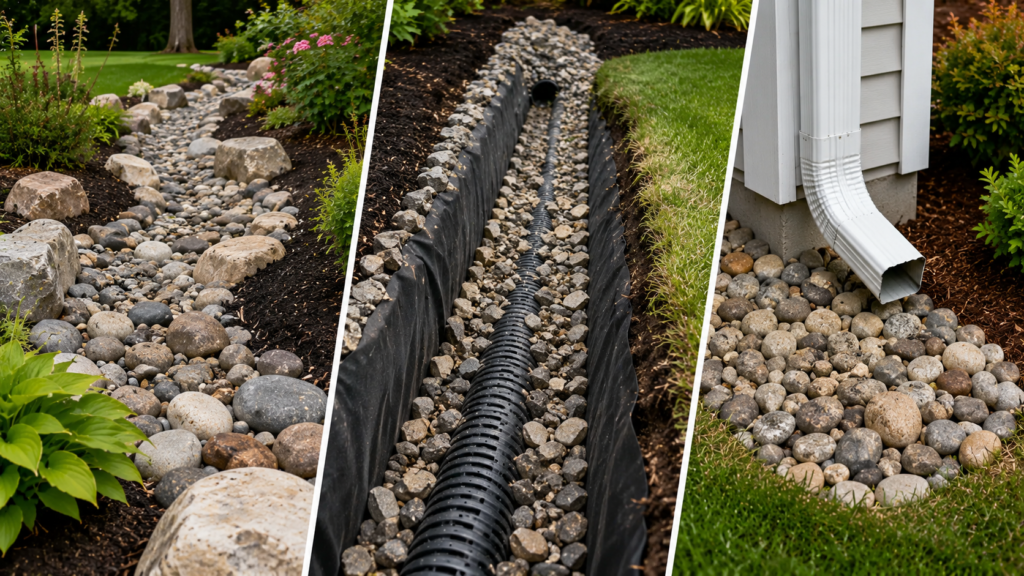
A French drain is a trench, usually lined with fabric, that holds a perforated pipe surrounded by drainage aggregate. The idea is simple: water enters through the gaps in the stone and the holes in the pipe, travels along the pipe, and exits at a planned outlet point away from the problem area.
The stone’s job is to let water in quickly while keeping the pipe from clogging with soil.
French drain gravel needs to stay relatively clean, meaning low in fines, so the spaces between each piece stay open. This is one of those situations where simply filling a trench with decorative rock isn’t the same as building a working French drain.
Decorative stone might look right, but if it’s the wrong size or has too many fines mixed in, the system won’t move water the way it’s supposed to.
Common mistakes with French drains include:
– Getting the slope wrong, so water sits in the pipe instead of flowing toward the outlet
– A clogged or crushed pipe that restricts flow
– Using unsuitable stone that compacts or lets soil migrate into the aggregate
– Not using enough stone around the pipe
– Poor outlet planning, so the water has nowhere useful to go once it leaves the trench
– Installing the drain before actually identifying where the water problem is coming from
A French drain that’s missing any of these pieces can still look finished on the surface while quietly failing underground.
Building a Dry Creek Bed With Landscape Stone
A dry creek bed is a shaped, stone-lined channel designed to look like a natural stream that happens to be dry most of the time. When it rains, it carries water away from the problem area instead of letting it sit or cut a new path through soil and mulch. Done well, it’s one of the more visually appealing ways to solve a drainage issue.
Building one that actually functions takes some planning. The channel needs enough width to handle concentrated runoff without overflowing its edges, and a shallow, gently sloped profile usually moves water more effectively than a narrow, deep cut.
Mixing stone sizes helps too: larger stones along the areas of stronger flow, particularly near the top of a slope or right where water first enters the channel, with smaller material filling in and stabilizing the bottom.
The edges should blend into the surrounding landscape rather than sitting as an abrupt line of rock in the middle of a lawn.
There’s a real difference between a decorative dry creek bed and one built primarily for drainage. A decorative version might just need to look good most of the year. A functional one needs to be sized and shaped for the actual volume of water it’s expected to carry.
Simply spreading a layer of stone over a wet area of the yard isn’t the same as constructing a channel engineered to move that water somewhere else; the ground underneath still needs the right shape and slope for the stone to do its job.
Managing Downspout Runoff With Stone
Roof runoff concentrates a large amount of water into one small point, which is exactly the kind of flow that erodes soil quickly. A downspout that discharges directly onto bare ground, especially close to a foundation, can wash out a channel in the soil within a season or two, something that becomes especially noticeable after Western New York’s heavier storms.
There are a few common approaches to downspout drainage. A splash block or stone-lined discharge area spreads the force of the water out over a wider surface right where it lands. A downspout extension moves the discharge point farther from the house before it hits the ground.
In some cases, an underground drainage line carries the water to a different part of the property entirely. Stone can also feed directly into a dry creek bed, using the discharge point as the start of a channel that carries water somewhere more useful.
Stone helps break up and disperse the force of that initial impact, reducing erosion around the downspout. For homes dealing with a larger volume of roof runoff, or where the discharge point is close to the foundation, a more controlled system, extensions, underground piping, or a properly graded channel may do more than stone on its own.
Using Drainage Stone for Erosion Control
Concentrated water is efficient at removing things it shouldn’t. Topsoil, mulch, grass seed, and other planting material can all wash away during a heavy storm, and slopes are particularly vulnerable since gravity is already working against the soil before the water even arrives.
Drainage rock and larger landscape stone slow that water down and give it a defined path instead of letting it cut new channels wherever it wants. On slopes, stone can stabilize the areas that see the most flow.
Along driveway edges, it can catch runoff before it undercuts the pavement. In garden beds, it can protect planting material from washing out during a storm. Drainage channels and areas beneath downspouts benefit from the same principle, giving water a defined, stone-lined path instead of an open, unprotected one.
Stone helps, but it isn’t a complete erosion solution by itself in every case. On a steep slope with a large volume of water, stone paired with proper grading and possibly plantings tends to hold up better than stone alone.
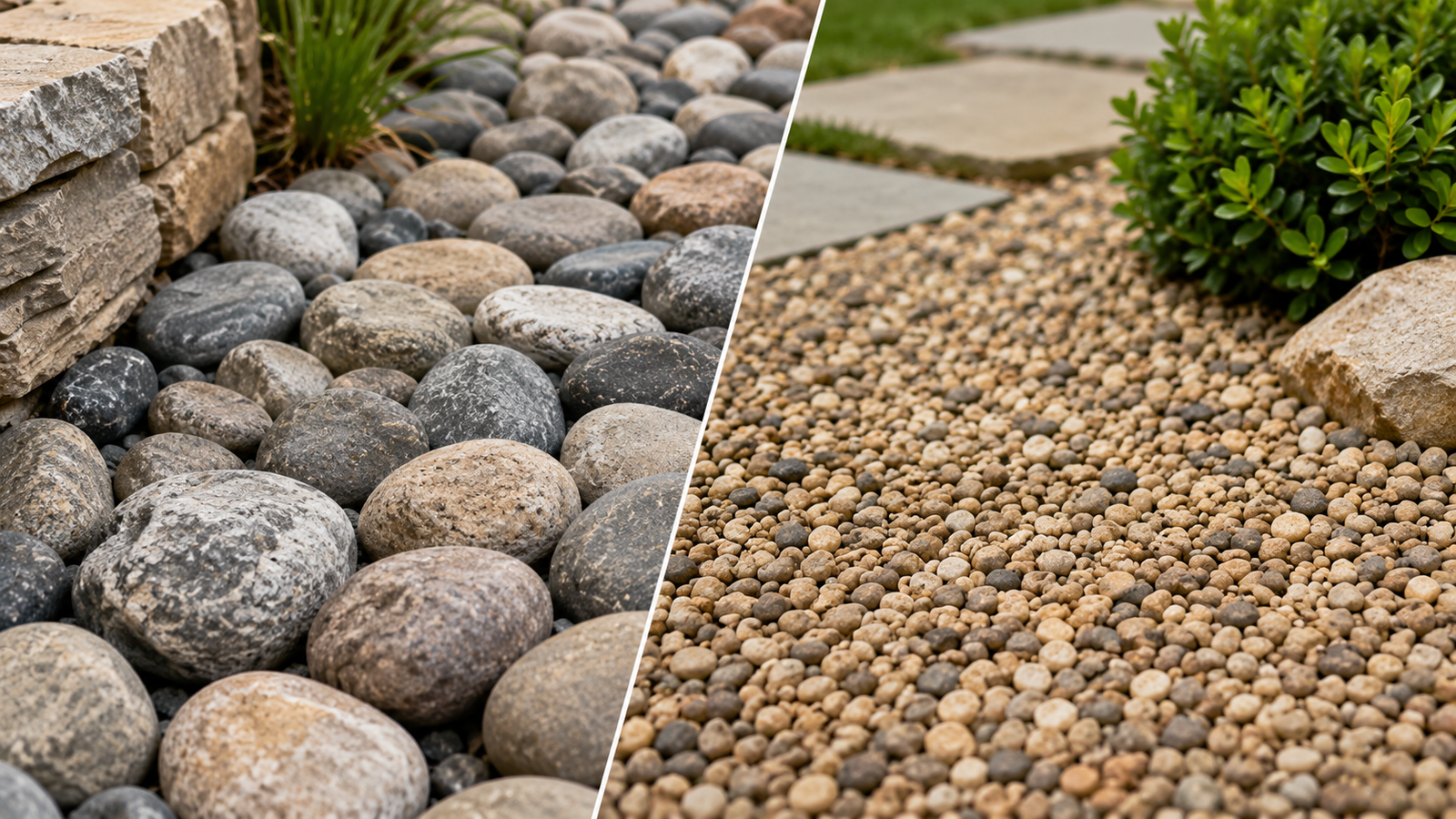
River Rock vs. Pea Gravel: Which Is Best for Your Yard?
Compare river rock and pea gravel for landscaping projects in Western New York. Learn about their size, appearance, drainage performance, maintenance requirements, durability, cost considerations, and common applications for pathways, garden beds, drainage areas, and other outdoor spaces.
Continue Reading →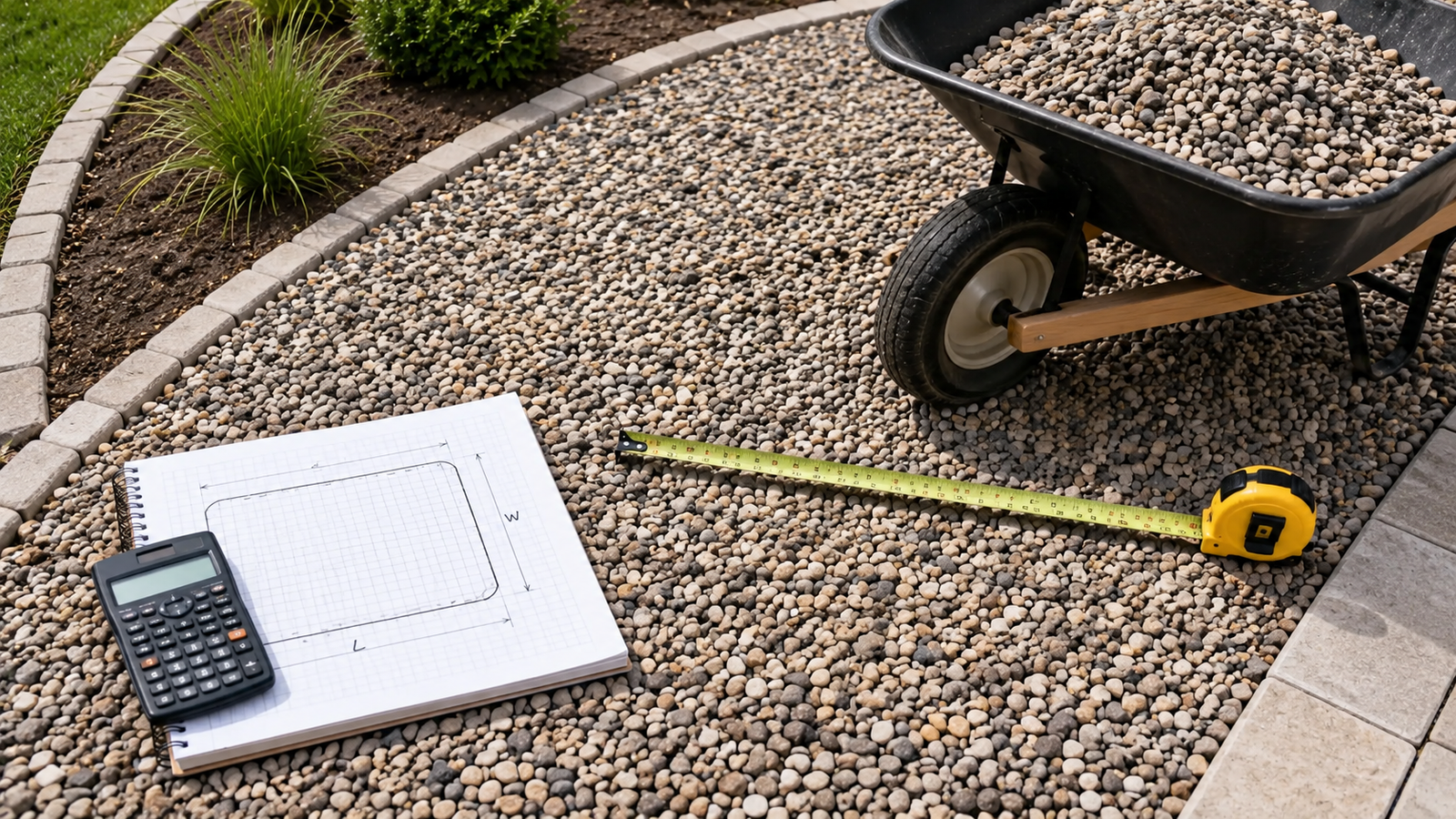
How Much Landscape Stone or Gravel Do I Need? Coverage Calculator Guide
Learn how to estimate the amount of landscape stone or gravel required for your yard project. Understand how to measure your project area, calculate square footage, determine the appropriate material depth, estimate cubic yards and tonnage, and plan your bulk landscape material delivery.
Continue Reading →How to Choose the Right Stone for Your Drainage Project
The table below is a general starting point, not an engineering specification. Every property is different, and the right choice often depends on the site.
| Drainage Problem | Potential Solution | Typical Material Consideration |
| Downspout erosion | Stone splash/discharge area | Larger drainage rock |
| Concentrated runoff | Dry creek bed | Mixed stone sizes |
| Subsurface water | French drain | Clean drainage aggregate |
| Sloped soil erosion | Stone-lined channel | Angular drainage rock |
| Decorative drainage feature | Dry creek bed | River rock/landscape stone |
| Small runoff area | Gravel or stone bed | Appropriately sized aggregate |
-For homeowners working through a drainage project in Buffalo or the surrounding Western New York area, KD Nursery carries a range of landscape and decorative stone options suited to different drainage applications, from functional aggregate to stone meant to finish off a dry creek bed.
Matching the material to the actual problem is what makes the difference between a drainage feature that works and one that just looks like it should.
Frequently Asked Questions
What is the best stone to use for drainage?
There isn’t one universal answer; it depends on the application. Clean, angular aggregate with few fines works well for French drains and subsurface flow, while larger drainage rock suits channels and areas with stronger, visible water movement.
Can I use river rock in a French drain?
River rock’s rounded shape doesn’t interlock as well as angular aggregate, and it’s often mixed with more fines than clean drainage stone. It can work in some applications, but angular drainage aggregate is generally the more reliable choice for subsurface French drains.
How deep should drainage stone be?
Depth depends on the application; a French drain trench is typically deeper than a surface channel or downspout discharge area. It should be deep enough to hold the pipe (if there is one) and enough aggregate to handle expected water volume without overflowing.
Is a dry creek bed better than a French drain?
Neither is universally better. A dry creek bed handles surface runoff and looks natural, while a French drain manages subsurface water through a buried pipe. The right choice depends on whether the water problem is happening above or below the ground.
Does drainage stone prevent weeds from growing in a dry creek bed?
Stone suppresses weeds, but organic debris settling in the gaps will eventually allow seeds to take root. Installing heavy-duty landscape fabric underneath the stone layer helps prevent long-term weed growth.
How do I clean dirt and leaves out of a stone drainage area?
Clear loose debris using a leaf blower on a low setting during dry weather. For trapped dirt and heavy buildup between stones, wash the area down with a garden hose attachment or pressure washer to restore proper water flow.
How do I know if I need a French drain or a dry creek bed?
Choose a dry creek bed for visible surface runoff, active erosion, or downspout pooling. Opt for a French drain if your lawn remains continuously saturated and spongy due to underground water or poorly draining soil.